OLV Is Not One Thing: Why Buying It as a Single Line Item Is Costing You

Four formats, a dozen tiers inside them, and a platform everyone keeps comparing it to that measures something else entirely.
Open almost any media plan and you will find the same line. OLV, a budget, a completion rate goal. One line item, one KPI, one algorithm deciding where all of it goes.
That line is doing a lot of hiding. Behind it sit four different formats, a dozen tiers inside them, and a set of buying decisions that nobody on the plan actually made. The DSP made them, at the lowest possible price, against a metric that cannot tell a sound-on pre-roll from a muted unit floating in the corner of the page. Then the campaign hits its number and the brand team asks why nobody remembers seeing the ad.
OLV is not one thing. It is a family of formats, each with tiers inside it, each behaving differently on the page and in front of a viewer. Treating it as a single programmatic buy is the root cause of most of the waste in the channel, and it is entirely fixable. This post is the argument for fixing it.
The formats
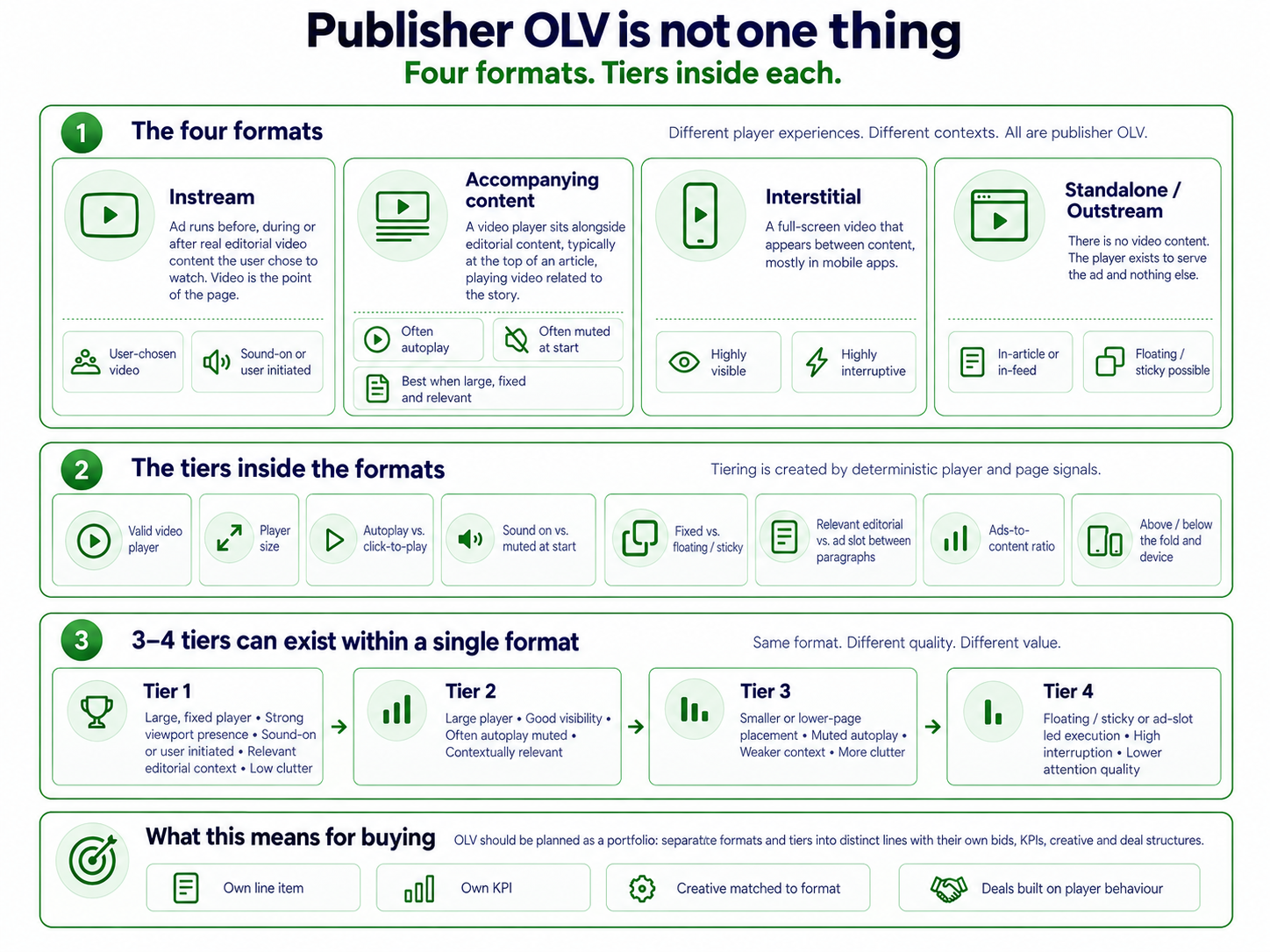
Start with what the industry actually sells under the OLV label. The IAB Tech Lab's 2022 video placement update gives us four categories, and they are worth knowing cold.
Instream. The ad runs before, during or after real editorial video content that the user chose to watch. The video is the point of the page. Sound is on by default, or the user clicked to play. This is the format everyone pictures when they say OLV.
Accompanying content. A video player that sits alongside editorial content, typically at the top of an article, playing video that relates to the story. It is often autoplay and muted at start. It is a legitimate, valuable format when the player is large, fixed and relevant. It is also the label most often stretched to cover things it should not.
Interstitial. A full-screen video that appears between content, mostly in mobile apps. Highly visible, highly interruptive, and a very different attention dynamic to anything sitting inside a page.
Standalone, or outstream. There is no video content. The player exists to serve the ad and nothing else. In-article units between paragraphs, in-feed units in a scroll, floating or sticky units that follow the reader down the page. The value exchange is different here: there is no content the viewer came for, so the ad is the interruption, not the price of admission.
Here is the complication. The industry is running two definitions at once. The legacy placement field that most bidding still keys off allows muted autoplay to pass as instream. The 2022 update does not. Plenty of supply is declared under the old rules and bought under the assumptions of the new ones. That gap between the label and the lived experience is where mislabelled inventory hides, and I have written before about how that gap is worth 20 to 30 percent of programmatic video spend.
The tiers inside the formats
Knowing the four formats gets you to the starting line. The real differences live inside them.
Take two placements that are both correctly labelled instream on the same premium publisher. One is a large fixed player at the top of a video article, sound on, user initiated, the ad running against content the reader deliberately chose. The other is a small player buried below the fold, autoplaying muted, collapsing into a corner unit when the reader scrolls past it. Same label. Same domain. Same line item. One earns attention, the other earns a completion because the reader cannot find the close button.
The variables that create these tiers are deterministic. They can be observed and measured on every page:
- Is there a valid video player at all, and is it one you can actually transact on?
- Player size and how much of the viewport it dominates
- Autoplay or click to play
- Sound on or muted at start
- Fixed in position or floating, sticky and following the user
- Embedded in relevant editorial or dropped into an ad slot between paragraphs
- The ratio of ads to content around it
- Above or below the fold, and on which device
Run those variables across any inclusion list and you get three or four distinct tiers within instream alone, and the same again within accompanying content and outstream. Two placements on one site can sit three tiers apart. Domain-level thinking cannot see any of this. Placement-level thinking sees all of it.
Why the single line item fails
Now put all of that behind one line item with one completion rate goal and watch what the DSP does.
The algorithm has a single instruction: find completed views at the lowest cost. It will find them. It will find them in the muted sticky unit that completes because nobody can escape it. It will find them in the small autoplay player that nobody saw. It will find them in the outstream slot that clears at a third of the price of real instream and reports a completion rate that looks respectable on a dashboard. The algorithm is not misbehaving. It is doing exactly what it was told, against a metric that treats a sound-on pre-roll and a floating corner unit as the same event.
Then the blended number arrives. A 70 percent completion rate looks healthy. Underneath it is 92 percent on the tier one instream that got 20 percent of the budget and 40 percent on the outstream that got the rest. The average hides the decision that was quietly made for you.
The fix is structural, and it is not complicated.
Separate the formats and the tiers into their own line items. Instream, accompanying content and outstream are different products. Tier one instream and tier three instream are different products. Give each its own line.
Give each line its own bid, KPI and floor. Sound-on instream should carry a higher bid and a higher completion and attention expectation. Outstream should be bought on viewable reach and priced accordingly. Expecting the same CPCV from both guarantees the budget flows to the wrong one.
Match creative to format. Sound-on instream can carry the full narrative. Muted accompanying content and outstream need captions and a visual hook in the first two seconds. One creative across all of OLV is a compromise on every placement.
Set frequency caps per format, because a viewer who saw the pre-roll and then the sticky unit on the next article has been reached twice by the same campaign in two very different ways.
Structure deals around player behaviour, not domain lists. Curated deals built on the tiers above give you control over the experience you are buying. A domain list gives you control over the logo on the letterhead.
Decide the mix yourself. The split between instream, accompanying content and outstream is a planning decision about reach, cost and impact. When it sits inside a single line item, that decision is delegated to the algorithm, and the algorithm always chooses cheap.
None of this requires new technology. It requires the plan to reflect what OLV actually is. At Vidium we built our whole OLV approach on these signals, and our campaigns average 80 percent completion at 22 percent above the OLV attention benchmark. Those numbers are not magic. They are what happens when you stop buying OLV as one thing.
YouTube is not publisher OLV
Which brings me to the comparison I hear in almost every planning conversation: publisher OLV versus YouTube, on the same slide, against the same benchmark.
This is not a knock on YouTube. It is one of the most powerful video platforms in the world and we buy it for clients through Vidium Direct. The point is narrower and more important: the two cannot share a column in a spreadsheet, because they do not measure the same thing.
A view is not a completion. On YouTube's skippable in-stream format, a view is counted when someone watches 30 seconds, or the whole ad if shorter, or interacts with it. On publisher OLV, completion means the full ad played through to the final quartile. A 60 percent YouTube view rate and a 60 percent publisher completion rate describe two different events.
CPV is not CPM. Skippable YouTube is priced on the view. Publisher OLV is priced on the impression and evaluated on the completed view. Putting a CPV next to a CPCV and declaring one cheaper is comparing a numerator to a denominator.
Skippable is a different creative problem. After five seconds the viewer chooses. The creative has one job: earn the next 25 seconds. Publisher pre-roll is typically non-skippable and runs 15 or 30 seconds in full. The same asset will behave completely differently across the two, and the results will tell you as much about the format as the message.
The context is different. YouTube is lean-in, user-chosen video, sound on, increasingly watched on the living room television. Publisher OLV is video inside a reading environment, on a recognised editorial brand, alongside journalism and content the audience trusts. Both are valuable. They are not interchangeable, and they reach people in different mindsets.
The measurement is different. YouTube is a walled garden. You get channel-level reporting, Google's own measurement suite and a limited set of third-party partners. Publisher OLV is the open web. You get URL-level transparency, independent viewability, attention measurement on every impression, carbon data and log-level detail if you want it. One of these lets you audit the buy. The other asks you to trust it.
Even the pipes are different. YouTube is bought through Google's own platforms and nowhere else. Publisher OLV is available through any DSP and any deal structure you choose. You could not put them in the same line item if you tried, which should tell you something about putting them in the same benchmark.
The right framing is complementary reach and complementary contexts. Plan them side by side with their own KPIs and their own success criteria. Never rank one against the other on a metric that only one of them reports.
Treat OLV as a portfolio
The single OLV line item made sense when the channel was young and the priority was scale. That phase is over. The supply is mature, the formats are distinct, the tiers are observable, and the tools to buy each one on its own terms already sit inside every DSP.
What has not caught up is the plan. Four formats, tiered by how the player actually behaves, each with its own line, bid, KPI, creative and deal. YouTube alongside, measured on its own terms. That is not more complicated. It is the same budget, better understood, spent on the experiences the brand thought it was paying for all along.
If you want to see what your OLV looks like when it is broken down by format and tier rather than averaged into one number, get in touch at vidium.co.
Elliot MacNay Co-Founder and Managing Director, Vidium