June 29, 2026
10 mins

Elliot MacNay

See how Vidium can deliver better quality supply, improved performance and cost efficiency with more insights for your next campaign
Cannes always sets the agenda for the year ahead. This year, we are leaving with two announcements that take Vidium well beyond where we started. The first opens up managed access to the most sought-after video inventory on the planet. The second moves our AOS optimisation from the report into the live bidstream. Two different problems, one organising idea: quality should decide where video budgets go.
Premium video is where audiences are, and it is also where buying is hardest. Streaming, premium publisher OLV and the big platforms each sit in their own silo, with their own targeting logic and their own way of reporting success. Reach is fragmented, targeting is inconsistent, and measurement rarely travels across screens.
Vidium Direct is our answer and our first managed-service offering. We layer our technology on top of the leading DSPs to give you a single route into Netflix, Broadcaster Apps, Disney, Paramount, Spotify, YouTube, Reddit and premium publisher OLV. One brief, one team, one set of outcomes, across CTV and online video.
Underneath that simplicity sits an agentic orchestration layer, built across the leading DSPs and platform ad managers. It runs the entire campaign as a single system. Activation happens from one point rather than platform by platform. Optimisation runs continuously across the entire portfolio, moving budget to what works in concert rather than in isolation. And insights come back unified, so you read one clear story rather than stitching together a dozen dashboards. The fragmentation stays under the hood; the experience stays seamless.
What makes it different is how we target. Most premium video still leans on blunt demographics or tired segments. We have built a unified targeting layer from Trends data: what people are actually watching, drawn from the world's leading video platforms, combined with what people are actually saying, drawn from the web's most active conversation communities. Pairing viewing behaviour with live conversation lets us follow genuine cultural attention and spend on it consistently, no matter which platform the impression runs on.
And every impression is measured against our Attention Opportunity Score (AOS), the attention dataset we built specifically for OLV and CTV. So you are not just reaching premium environments; you are reaching the ones that actually earn attention, with proof that travels across the whole buy.
On the programmatic side, attention has always had a timing problem. It usually arrives after the auction, in a report, once the money is already spent. Useful for the next campaign, too late for this one.
We have changed that. Working inside the cloud environment of one of the world's leading exchanges, we will run AOS as a containerised service co-located with the auction itself. Opportunities are scored in real time, inside the bidstream, within the milliseconds an auction allows.
The result is a step change in control. Instead of optimising at the deal or domain level, you can now bid and optimise on quality and attention at the individual impression, as it happens, with insight flowing back in real time. Higher-attention impressions get the budget they deserve; the rest stop draining it. Same supply, sharper decisions, measured at the point they are made.
These launches point in the same direction. Vidium Direct brings attention-led buying to the premium managed market, across the platforms everyone wants and few can unify. The exchange cloud integration brings the same discipline into programmatic, at the impression level and in real time.
Premium reach, culturally relevant targeting, and attention you can act on rather than just admire after the fact. That is the standard we are building toward, and both launches will be live during Q3/H2.
Want to see either in action? Get in touch at vidium.co.

Four formats, a dozen tiers inside them, and a platform everyone keeps comparing it to that measures something else entirely.
Open almost any media plan and you will find the same line. OLV, a budget, a completion rate goal. One line item, one KPI, one algorithm deciding where all of it goes.
That line is doing a lot of hiding. Behind it sit four different formats, a dozen tiers inside them, and a set of buying decisions that nobody on the plan actually made. The DSP made them, at the lowest possible price, against a metric that cannot tell a sound-on pre-roll from a muted unit floating in the corner of the page. Then the campaign hits its number and the brand team asks why nobody remembers seeing the ad.
OLV is not one thing. It is a family of formats, each with tiers inside it, each behaving differently on the page and in front of a viewer. Treating it as a single programmatic buy is the root cause of most of the waste in the channel, and it is entirely fixable. This post is the argument for fixing it.
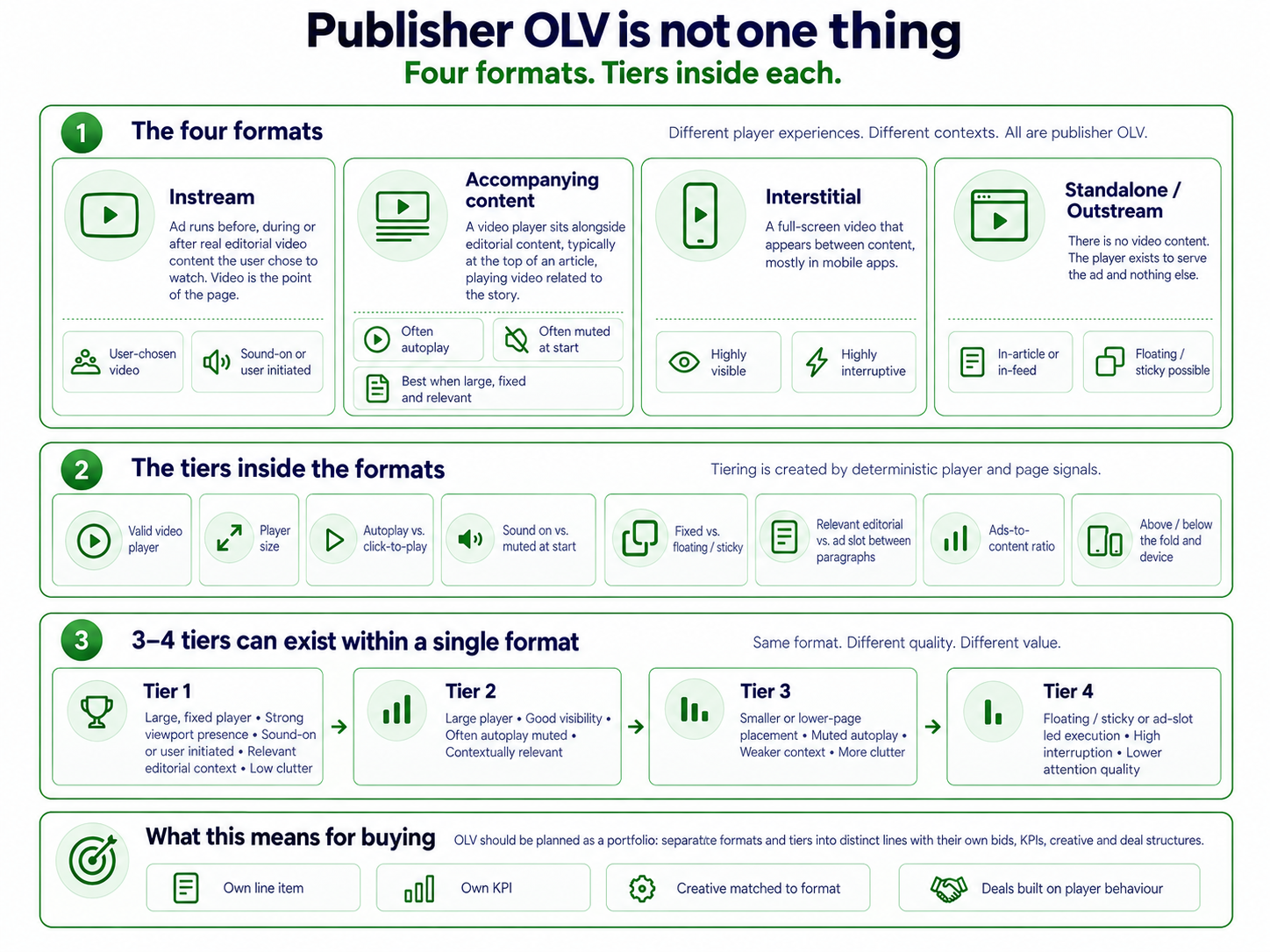
Start with what the industry actually sells under the OLV label. The IAB Tech Lab's 2022 video placement update gives us four categories, and they are worth knowing cold.
Instream. The ad runs before, during or after real editorial video content that the user chose to watch. The video is the point of the page. Sound is on by default, or the user clicked to play. This is the format everyone pictures when they say OLV.
Accompanying content. A video player that sits alongside editorial content, typically at the top of an article, playing video that relates to the story. It is often autoplay and muted at start. It is a legitimate, valuable format when the player is large, fixed and relevant. It is also the label most often stretched to cover things it should not.
Interstitial. A full-screen video that appears between content, mostly in mobile apps. Highly visible, highly interruptive, and a very different attention dynamic to anything sitting inside a page.
Standalone, or outstream. There is no video content. The player exists to serve the ad and nothing else. In-article units between paragraphs, in-feed units in a scroll, floating or sticky units that follow the reader down the page. The value exchange is different here: there is no content the viewer came for, so the ad is the interruption, not the price of admission.
Here is the complication. The industry is running two definitions at once. The legacy placement field that most bidding still keys off allows muted autoplay to pass as instream. The 2022 update does not. Plenty of supply is declared under the old rules and bought under the assumptions of the new ones. That gap between the label and the lived experience is where mislabelled inventory hides, and I have written before about how that gap is worth 20 to 30 percent of programmatic video spend.
Knowing the four formats gets you to the starting line. The real differences live inside them.
Take two placements that are both correctly labelled instream on the same premium publisher. One is a large fixed player at the top of a video article, sound on, user initiated, the ad running against content the reader deliberately chose. The other is a small player buried below the fold, autoplaying muted, collapsing into a corner unit when the reader scrolls past it. Same label. Same domain. Same line item. One earns attention, the other earns a completion because the reader cannot find the close button.
The variables that create these tiers are deterministic. They can be observed and measured on every page:
Run those variables across any inclusion list and you get three or four distinct tiers within instream alone, and the same again within accompanying content and outstream. Two placements on one site can sit three tiers apart. Domain-level thinking cannot see any of this. Placement-level thinking sees all of it.
Now put all of that behind one line item with one completion rate goal and watch what the DSP does.
The algorithm has a single instruction: find completed views at the lowest cost. It will find them. It will find them in the muted sticky unit that completes because nobody can escape it. It will find them in the small autoplay player that nobody saw. It will find them in the outstream slot that clears at a third of the price of real instream and reports a completion rate that looks respectable on a dashboard. The algorithm is not misbehaving. It is doing exactly what it was told, against a metric that treats a sound-on pre-roll and a floating corner unit as the same event.
Then the blended number arrives. A 70 percent completion rate looks healthy. Underneath it is 92 percent on the tier one instream that got 20 percent of the budget and 40 percent on the outstream that got the rest. The average hides the decision that was quietly made for you.
The fix is structural, and it is not complicated.
Separate the formats and the tiers into their own line items. Instream, accompanying content and outstream are different products. Tier one instream and tier three instream are different products. Give each its own line.
Give each line its own bid, KPI and floor. Sound-on instream should carry a higher bid and a higher completion and attention expectation. Outstream should be bought on viewable reach and priced accordingly. Expecting the same CPCV from both guarantees the budget flows to the wrong one.
Match creative to format. Sound-on instream can carry the full narrative. Muted accompanying content and outstream need captions and a visual hook in the first two seconds. One creative across all of OLV is a compromise on every placement.
Set frequency caps per format, because a viewer who saw the pre-roll and then the sticky unit on the next article has been reached twice by the same campaign in two very different ways.
Structure deals around player behaviour, not domain lists. Curated deals built on the tiers above give you control over the experience you are buying. A domain list gives you control over the logo on the letterhead.
Decide the mix yourself. The split between instream, accompanying content and outstream is a planning decision about reach, cost and impact. When it sits inside a single line item, that decision is delegated to the algorithm, and the algorithm always chooses cheap.
None of this requires new technology. It requires the plan to reflect what OLV actually is. At Vidium we built our whole OLV approach on these signals, and our campaigns average 80 percent completion at 22 percent above the OLV attention benchmark. Those numbers are not magic. They are what happens when you stop buying OLV as one thing.
Which brings me to the comparison I hear in almost every planning conversation: publisher OLV versus YouTube, on the same slide, against the same benchmark.
This is not a knock on YouTube. It is one of the most powerful video platforms in the world and we buy it for clients through Vidium Direct. The point is narrower and more important: the two cannot share a column in a spreadsheet, because they do not measure the same thing.
A view is not a completion. On YouTube's skippable in-stream format, a view is counted when someone watches 30 seconds, or the whole ad if shorter, or interacts with it. On publisher OLV, completion means the full ad played through to the final quartile. A 60 percent YouTube view rate and a 60 percent publisher completion rate describe two different events.
CPV is not CPM. Skippable YouTube is priced on the view. Publisher OLV is priced on the impression and evaluated on the completed view. Putting a CPV next to a CPCV and declaring one cheaper is comparing a numerator to a denominator.
Skippable is a different creative problem. After five seconds the viewer chooses. The creative has one job: earn the next 25 seconds. Publisher pre-roll is typically non-skippable and runs 15 or 30 seconds in full. The same asset will behave completely differently across the two, and the results will tell you as much about the format as the message.
The context is different. YouTube is lean-in, user-chosen video, sound on, increasingly watched on the living room television. Publisher OLV is video inside a reading environment, on a recognised editorial brand, alongside journalism and content the audience trusts. Both are valuable. They are not interchangeable, and they reach people in different mindsets.
The measurement is different. YouTube is a walled garden. You get channel-level reporting, Google's own measurement suite and a limited set of third-party partners. Publisher OLV is the open web. You get URL-level transparency, independent viewability, attention measurement on every impression, carbon data and log-level detail if you want it. One of these lets you audit the buy. The other asks you to trust it.
Even the pipes are different. YouTube is bought through Google's own platforms and nowhere else. Publisher OLV is available through any DSP and any deal structure you choose. You could not put them in the same line item if you tried, which should tell you something about putting them in the same benchmark.
The right framing is complementary reach and complementary contexts. Plan them side by side with their own KPIs and their own success criteria. Never rank one against the other on a metric that only one of them reports.
The single OLV line item made sense when the channel was young and the priority was scale. That phase is over. The supply is mature, the formats are distinct, the tiers are observable, and the tools to buy each one on its own terms already sit inside every DSP.
What has not caught up is the plan. Four formats, tiered by how the player actually behaves, each with its own line, bid, KPI, creative and deal. YouTube alongside, measured on its own terms. That is not more complicated. It is the same budget, better understood, spent on the experiences the brand thought it was paying for all along.
If you want to see what your OLV looks like when it is broken down by format and tier rather than averaged into one number, get in touch at vidium.co.
Elliot MacNay Co-Founder and Managing Director, Vidium
A few weeks ago, we held Vidium's first-ever board meeting. On paper, it was a few hours of slides, numbers and hard questions. In reality, it was a milestone I had been quietly looking forward to since the day Joe and I decided to build this company.
A first board meeting forces you to do something founders rarely make time for: stop, look back, and be honest about what the journey has actually been. So that is what this post is. A reflection on how far Vidium has come, and a statement of intent about where we are going.
Two years ago, Vidium was a conviction shared between two people: that video is the most powerful medium in advertising, and that the way it gets bought has drifted far from the quality brands think they are paying for. Too much waste, too little transparency, and almost no connection between the label on an impression and the experience behind it.
So we built a video intelligence platform and supply solution with a simple organising idea: quality should decide where video budgets go. Attention-scored, carbon-aware, premium video across OLV and CTV, curated placement by placement rather than domain by domain, and activated straight into the buying platforms agencies already use.
Sitting in that boardroom meeting, the numbers told a story I am genuinely proud of.
Gross billings grew 251% year on year, comparing the first half of 2026 with the same period in 2025. The business has more than tripled.
We worked with 53 brands over the past year, 38 of them new to Vidium. That matters more to me than any headline growth figure, because it means the growth is broad, healthy and repeatable rather than resting on one or two relationships. Some of the world's most recognisable brands now anchor the book, across tech, retail, healthcare, automotive and entertainment.
We have also become a genuinely international business. UK and EMEA have grown from a sliver of billings to a third of the business in twelve months, sitting alongside a US operation that goes from strength to strength, with a growing team on the ground.
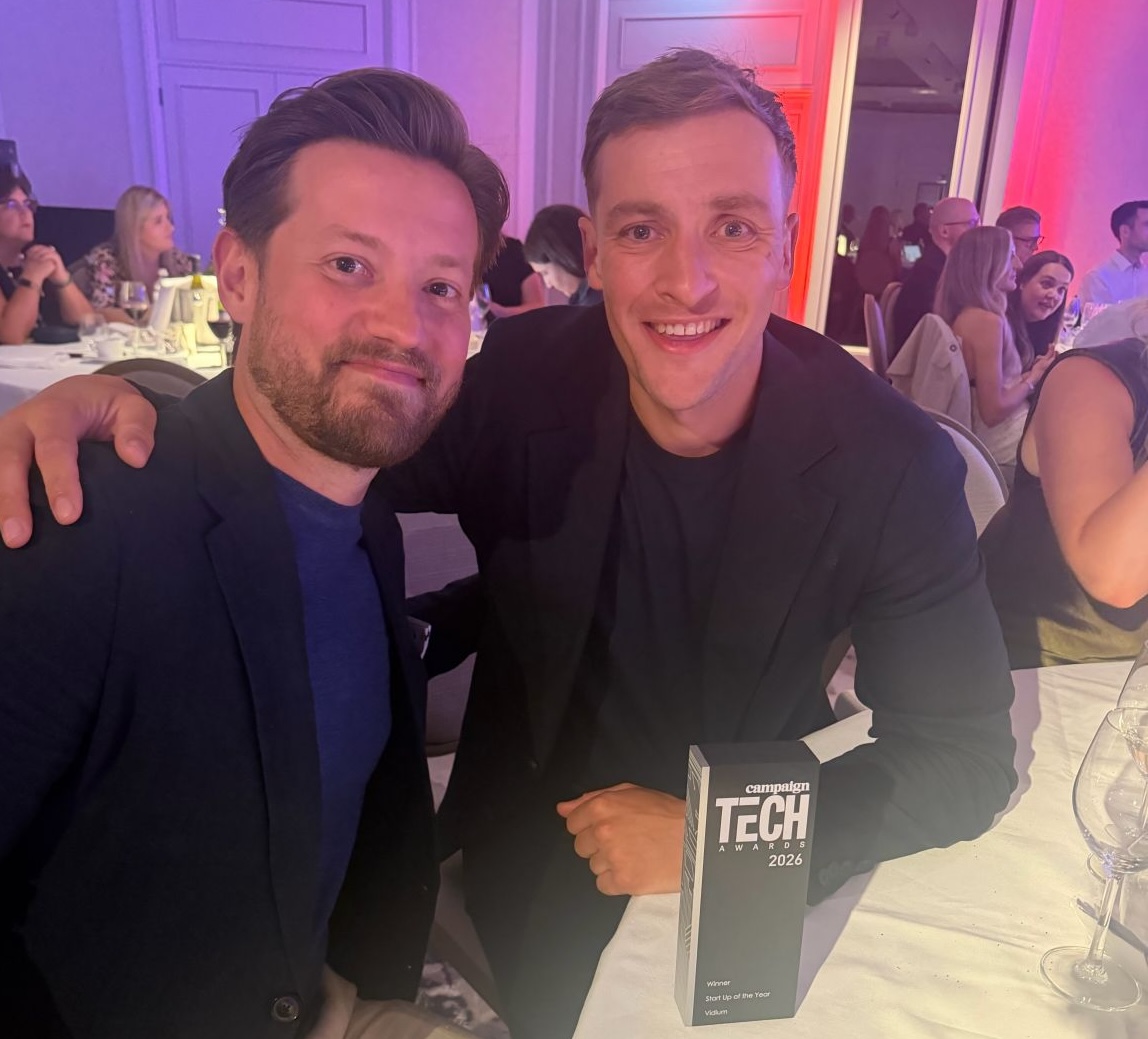
And in the middle of it all, we were named Start Up of the Year at the Campaign Tech Awards 2026. External recognition is never the goal, but I would be lying if I said that one did not feel special.
None of this happened by accident, and very little of it happened comfortably. We have shipped relentlessly.
Our Attention Opportunity Score (AOS) went from an idea to the backbone of everything we do. Carbon-aware measurement became standard on our campaigns rather than a bolt-on. We built deal automation into the world's biggest buying platforms, developed a Video Intelligence layer that inspects placements the way a human would, and expanded deep into CTV.
Then, straight after Cannes this summer, came our two biggest launches yet: Vidium Direct, our first managed-service offering unifying the most sought-after streaming and premium video platforms behind one brief, and AOS moving into the live bidstream, scoring quality in real time inside the auction itself. I wrote about both in more detail here.
Behind all of that is a small team that consistently punches several weight classes above its size. Engineers, sellers, advisors and partners who care about doing this properly. Thank you. You know who you are.
Here is the part I am proudest of: all of this growth has been organic.
No blitzscaling. No growth-at-any-cost playbook. We have grown the old-fashioned way: by doing excellent work, measuring it honestly, and earning the next campaign. Clients stay because the results are real, then they tell other people, and that compounding is worth more than any shortcut.
Our first board meeting was an extension of that philosophy. Bringing experienced operators around the table to challenge us, hold us accountable and sharpen the plan is exactly what a company should do when it stops being a project and starts being a business. We left the room with a clearer plan and higher ambitions than we walked in with.
That is the model going forward too. Sustainable, deliberate, compounding growth. We will keep reinvesting in the product, keep hiring carefully, and keep saying no to anything that trades long-term trust for short-term revenue.
The second half of 2026 is the most ambitious period we have ever planned, and we head into it with the strongest pipeline in our history. Vidium Direct and in-bidstream AOS both go live. Our US presence keeps expanding. And the standard we are building toward stays the same: premium reach, culturally relevant targeting, and attention you can act on rather than admire after the fact.
And on a personal note, the news I am most excited about: this autumn I am relocating to New York. The US is our largest market and the centre of gravity for premium video, and I want to be there in person, alongside our clients, our agency partners and our growing US team. Building Vidium from Europe has taken us a long way. Building it from New York, shoulder to shoulder with the people we serve, is the next chapter, and I cannot wait. See you soon, NYC.
If you want to see what quality-first video looks like for your next campaign, get in touch at vidium.co.
Elliot MacNay Co-Founder and Managing Director, Vidium

It’s widely reported that anywhere from 20% to 30% of programmatic video spend is lost due to supply-side misrepresentation, invalid traffic and low-quality inventory. That’s billions in wasted ad spend – not to mention billions in ad revenue siphoned away from premium publishers – further eroding high-quality video inventory.
If programmatic video is going to mature beyond the “scale at any cost” phase, we need to rethink how we activate and optimize toward higher-quality inventory. Self-declared inventory (accurate or not) doesn’t fully capture multidimensional video inventory, and static metadata snapshots don’t verify both the ad and content aspects of the video experience.
We need to start looking at the deterministic signals that tell us how video ads and the surrounding content behaves on the page to gain a much more relevant, fine-grained understanding of the actual viewing experience.

It’s easy to blame opportunistic publishers masking low-quality inventory for our current status quo, but we arrived here in a much more organic way.
Over the past five years, programmatic fundamentally democratized access to video. But to scale quickly, the industry developed labels as a proxy for ad experience. “Instream,” for example, implied a pre-, mid- or post-roll ad within real editorial video content. “CTV” implied a premium, lean-back viewing experience on a television screen. And premium OLV environments were expected to mirror that same immersive, video-first experience within web and mobile environments.
But as programmatic video supply has expanded and supply-side competition has intensified, that connection between the label and the lived ad experience is now far more ambiguous.
Inventory categorized as instream isn’t always anchored to meaningful editorial video content. In fact, instream-labeled inventory often sits on sites that don’t even have a valid video player to serve the format.
And in CTV, “premium” does not always deliver the immersive value advertisers assume they’re buying. Case in point, a large volume of premium advertisements are delivered on web or mobile browsers when most buyers expect their CTV ads to run on full-screen TVs.
That 20% to 30% inefficiency lives in the gap between label and experience.
So why does the inefficiency gap persist? Most ad technologies were built for static digital ads and later adapted to video. But video is an experience that unfolds over time. Quick snapshots of a page attain surface-level metadata. They miss key facets of how video actually behaves on the page.
And so we need to ask these important questions:
· First and foremost, is there a video player on the page?
· If yes, what type of video player is it – and is it one via which we can buy/transact?
· Does the player autoplay or require a click?
· Does it initiate muted or with sound?
· Does it stay fixed on the page or collapse into a small floating unit that follows the user?
· Is it embedded in meaningful editorial content or dropped into an outstream container between paragraphs?
· Does it expand, reposition or interrupt the reading experience?
These nuances make all the difference for whether an impression feels premium and immersive – or intrusive and ignorable. But parsing those data points requires looking beyond what the code says to observe how the player behaves in real conditions.
That means analyzing video placements at the URL level, staying on the page long enough to see how the player functions and capturing execution-level signals that the quick crawls of traditional ad verifiers typically miss. It also means evaluating not just whether a player exists, but the size, placement integrity, movement behavior and the ratio of ads to content surrounding it.
Looking at video at the placement level rather than broadly categorizing an entire domain gives brands a more precise picture. Two placements on the same site can deliver dramatically different experiences.
Once you see the full picture, you can act on it. Spend can be directed toward truly premium, high-impact placements. Intrusive sticky units can be filtered out. In-article video that commands attention can be distinguished from low-attention outstream ads. Private marketplace deals can be structured around player behaviors instead of broad site lists.

The advertiser benefit of these deeper insights is obvious. If even a fraction of that 20% to 30% inefficiency is reclaimed, performance and ROI lifts will be sizeable. But the ripple effects benefit the entire ad ecosystem.
When loosely categorized or lower-quality supply competes in the same marketplace as truly high-quality inventory at a lower price point, it penalizes publishers that are investing in those more premium video experiences. By contrast, better insights drive more ad dollars toward publishers that have invested in premium experiences, such as real video infrastructure, editorial content and thoughtful ad deployment. This strengthens the economic foundation for high-quality content creation, supporting the exact environments that brands say they want to fund.
Even consumers win in this shift, because they experience fewer cluttered deployments, fewer intrusive ad placements and more relevant ad content delivered in environments that feel intentional rather than opportunistic – not to mention providing economic support for the high-quality content that we all want.
The best part of this shift is that it doesn’t require a heavy infrastructure rebuild. The high-quality video environments brands want already exist – and there’s more than enough scale within placements that deliver strong player integrity, thoughtful deployment and immersive viewing contexts. It’s just hard to find them in today’s cluttered supply landscape.
Capturing and applying these execution-level signals will drive immediate impact, redirecting spend and producing near-term gains. As those gains become visible, momentum will build quickly across the industry. More brands will embrace this refined approach, more ad dollars will flow to high-quality environments and premium publishers will have the economic support to expand their high-quality video inventory.
This is a classic story of market maturity.
Programmatic video was built to scale as fast as possible and it succeeded, exploding across the open web and CTV in less than a decade.
But scale breeds complexity, and inclusion lists of domains and apps now stretch into the thousands, making it incredibly complex to verify how video is actually deployed. Moreover, when we focus too much on CPM efficiency to drive decision-making, qualitative differences blur. And when labels are largely self-declared, inconsistencies persist.
That’s why every fast-growing market eventually transitions from expansion to refinement. Programmatic video is at that inflection point.
The inefficiencies we see represent the tremendous opportunity in front of us all right now. The next decade will be about assembling supply more intelligently, moving from one-dimensional labels and surface-level assumptions to looking deeper and having a behavioral understanding of execution.

See how Vidium can deliver better quality supply, improved performance and cost efficiency with more insights for your next campaign

